Industrial Electrical Control Panel: Features That Actually Matter

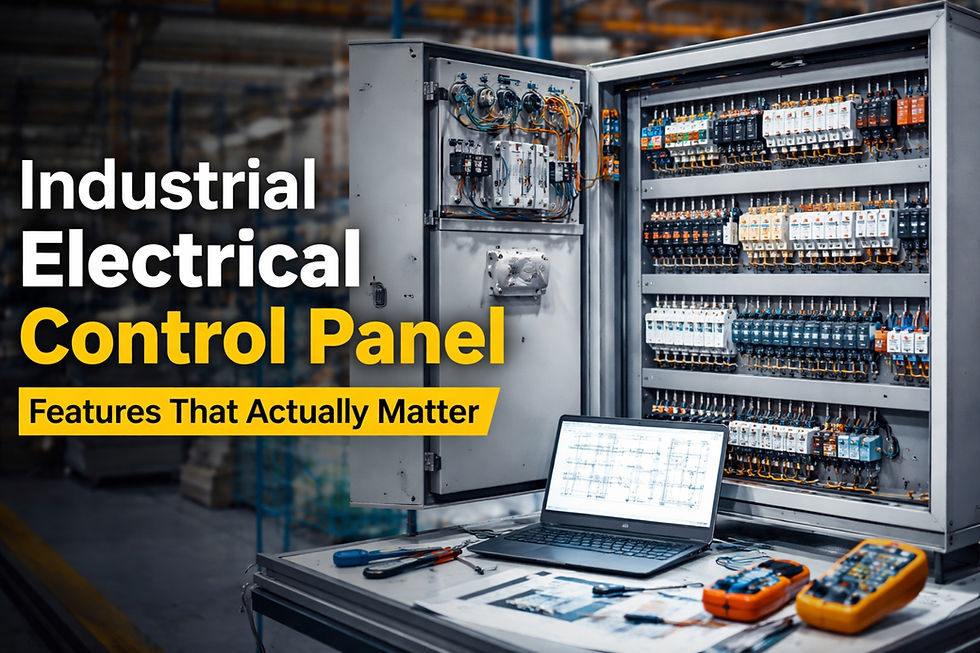
What Is an Industrial Electrical Control Panel?
An industrial electrical control panel is a structured assembly of electrical components—such as circuit breakers, contactors, relays, PLCs, busbars, VFDs, and protection devices enclosed within a metal cabinet—to control, monitor, and distribute power to industrial machinery and processes. It acts as the operational brain of manufacturing plants, water treatment systems, power distribution networks, and automated production lines.
In simple terms, if machines are the muscles of industry, the control panel is the nervous system that keeps everything coordinated, safe, and efficient.
Yet, despite its importance, many businesses still treat panel selection as a cost-based purchase instead of a safety-critical engineering decision. That approach often leads to overheating, short circuits, production downtime, electrical fires, and compliance failures—mistakes that can cost far more than the initial savings.
Let’s break down the features that actually matter when choosing or designing an industrial electrical control panel.
Why Industrial Control Panels Fail (And Why It Matters)
Electrical panel failures are rarely “sudden.” They’re usually the result of overlooked design flaws:
Poor heat dissipation
Underrated circuit protection
Loose terminations
Inadequate short-circuit withstand capacity
Substandard busbar design
Lack of surge protection
Improper earthing
Non-compliance with safety standards
According to global electrical safety research, electrical faults contribute significantly to industrial fires, with overloaded circuits and poor wiring among the top causes. In India alone, electrical short circuits account for a large percentage of industrial fire incidents annually.
Downtime from a failed panel can cost:
₹50,000–₹5,00,000 per hour in manufacturing environments
Production delays
Equipment damage
Regulatory penalties
Worker safety risks
This is why selecting the right industrial electrical control panel—and the right electrical control panel manufacturers—is critical.
Features That Actually Matter in an Industrial Electrical Control Panel
Let’s go beyond the brochure features and focus on what truly impacts performance, safety, and ROI.
1. Short-Circuit Withstand Capacity (SCCR)
One of the most overlooked specifications is Short-Circuit Current Rating (SCCR).
If the panel cannot withstand the available fault current at your facility, it becomes a safety hazard. For example:
If your facility has a 50kA fault level
And your panel is rated for only 25kA
You risk catastrophic failure during a short circuit
Always verify:
Incoming fault current from utility
Breaker interrupting capacity
Busbar short-circuit rating
A properly engineered industrial electrical control panel will match or exceed site fault levels.
2. Thermal Management & Heat Dissipation
Heat is the silent killer of electrical systems.
For every 10°C rise above rated temperature, the lifespan of electrical components can reduce significantly. Overheating leads to:
Insulation breakdown
Relay malfunction
PLC failure
VFD trips
Effective thermal management includes:
Ventilated enclosures
Forced cooling fans
Heat exchangers
Air conditioners (for high-density panels)
Proper spacing between components
Thermal imaging during commissioning is an expert-level best practice that many quality electrical control panel manufacturers follow.
3. Enclosure Rating (IP & Material Quality)
Industrial environments vary—from dusty cement plants to humid food-processing units. The enclosure must match the environment.
Common IP ratings:
IP54 – Dust & splash resistant
IP65 – Dust tight & water jet resistant
IP66 – High-pressure washdown resistant
Material options:
CRCA steel with powder coating
Stainless steel (for corrosive environments)
Aluminum (lightweight applications)
A poorly selected enclosure leads to corrosion, dust ingress, and premature failure.
4. Component Quality & Brand Integrity
The internal components matter more than the outer cabinet.
High-quality panels use:
Reputed MCB/MCCB brands
Industrial-grade contactors
PLCs from reliable automation brands
Copper busbars (not aluminum substitutes in heavy-duty use)
Cheap substitutes increase:
Voltage drops
Heat generation
Maintenance frequency
When searching for electrical panel manufacturers near me, always ask for component brand lists and test certificates.
5. Busbar Design & Current Distribution
Busbars are the backbone of power distribution inside the panel.
Critical factors:
Copper purity (99.9% electrolytic copper preferred)
Proper insulation sleeves
Correct cross-sectional sizing
Adequate spacing for heat dissipation
A well-designed busbar reduces:
Energy loss
Voltage imbalance
Arc flash risk
Advanced manufacturers now provide temperature rise test data—a strong indicator of engineering quality.
6. Protection & Safety Mechanisms
A reliable industrial electrical control panel must include layered protection:
Overcurrent protection
Short circuit protection
Earth fault protection
Surge protection devices (SPD)
Phase failure relays
Under/over voltage protection
For critical industries like pharmaceuticals or data centers, redundancy and backup systems are essential.
7. Compliance with Standards
Never compromise on compliance.
Indian & global standards include:
IS/IEC 61439 (Low-voltage switchgear assemblies)
IEC 60947 (Switchgear & controlgear)
CE certification (export markets)
Compliance ensures:
Tested safety
Performance verification
Legal protection
Professional electrical control panel manufacturers provide complete test reports, not just verbal assurance.
8. Expandability & Future-Proof Design
Industries grow. Your panel should too.
A good design includes:
20–30% spare capacity
Extra DIN rail space
Spare MCCB slots
Provision for additional PLC modules
Future-proof panels reduce upgrade costs and production interruptions.
9. Smart Monitoring & Industry 4.0 Integration
Modern industrial electrical control panels are no longer passive systems.
Smart features include:
Energy monitoring meters
IoT gateways
Remote diagnostics
SCADA connectivity
Cloud-based fault alerts
Energy monitoring alone can reduce electricity consumption by 5–15% in energy-intensive industries through data-driven decisions.
10. Wiring Standards & Documentation
Messy wiring isn’t just ugly—it’s dangerous.
Best practices:
Ferruled wires
Proper numbering system
Clear terminal labeling
Updated wiring diagrams
Cable segregation (power vs control)
Professional documentation simplifies maintenance and reduces troubleshooting time dramatically.
How to Evaluate Electrical Control Panel Manufacturers
When businesses search for “electrical panel manufacturers near me,” they often compare price first. Instead, evaluate based on:
✔ Engineering Capability
Do they have in-house design engineers?
✔ Testing Facility
Do they conduct routine & type tests?
✔ After-Sales Support
Is technical assistance available onsite?
✔ Project Portfolio
Have they served similar industries?
✔ Customization Capability
Can they design as per load study and site conditions?
Cost of Poor Panel Design
Consider a mid-sized manufacturing unit operating 18 hours daily.
Panel overheating caused MCCB trips
Production halted twice weekly
Downtime cost ₹1,20,000 per incident
Annual loss exceeded ₹1 crore
Root cause?
Undersized busbars and poor ventilation.
Upgrading to a properly engineered industrial electrical control panel eliminated downtime and improved operational stability.
The right panel isn’t an expense—it’s insurance against loss.
Industrial Electrical Control Panel vs Standard Electrical Panel
Feature | Standard Panel | Industrial Electrical Control Panel |
Load Handling | Moderate | Heavy-duty, continuous |
Safety Level | Basic | Multi-layer protection |
Compliance | Limited | IS/IEC certified |
Automation | Minimal | PLC/SCADA ready |
Environmental Suitability | Indoor only | Harsh industrial conditions |
Expert Tips Before You Finalize a Panel
Always conduct a load study
Confirm fault level calculations
Ask for GA (General Arrangement) drawings
Verify copper busbar sizing
Demand FAT (Factory Acceptance Test)
Inspect panel before dispatch
FAQs
1. What is the lifespan of an industrial electrical control panel?
Typically 15–25 years, depending on component quality and maintenance.
2. How often should panels be inspected?
Thermal scanning every 6–12 months is recommended.
3. Can panels be customized?
Yes, reputable electrical control panel manufacturers design fully customized solutions.
4. How do I find reliable electrical panel manufacturers near me?
Look beyond Google listings—verify certifications, projects, and client testimonials.
Conclusion: Engineering Over Economics
An industrial electrical control panel is not a commodity product—it is a precision-engineered safety system that protects assets, people, and productivity.
Choosing the lowest bidder often results in higher long-term costs. Instead, focus on:
Engineering accuracy
Compliance
Component quality
Thermal performance
Future scalability
If you are currently searching for electrical panel manufacturers near me, prioritize those who demonstrate technical transparency, testing capability, and real-world project experience.
Call to Action
Looking to upgrade or install a high-performance industrial electrical control panel? Partner with experienced electrical control panel manufacturers who prioritize safety, efficiency, and long-term reliability.
Get a professional load assessment and panel design consultation today—because in industrial power systems, precision isn’t optional. It’s essential.

Comments